

The revenue your encounter data can already prove.
PROMETHEUS reads the encounter and diagnosis data your PACE program already submits, finds the risk-adjusted revenue that never made it to CMS, and puts an evidence trail behind every dollar it claims.
A guided walkthrough takes about 30 minutes. Nothing to install.

Three things your team will see in the first ten minutes.
Who to see before year-end
Every participant with conditions credited last year and nothing credited yet this year, in one list — ranked by what is expected back. One click hands it to your care team as a spreadsheet.
Whose documentation comes back
Provider Scorecards by center and by provider: what was documented last year and credited again this year, and what is still at stake. A leadership copy with dollars; a provider copy without.
Chronic or acute, on every item
Each condition marked chronic or acute — from the federal list, adjusted to your own clinical team's calls — so your team chases what should come back and skips what should not.
Thirty minutes on synthetic PACE data. PROMETHEUS never suggests a diagnosis — your providers decide.
PACE programs are paid on risk they can't always see.
Capitation follows documented, submitted, accepted diagnoses. Every step in that chain leaks — and most PACE programs have no instrument that watches the whole chain at once.
Conditions documented, never recaptured
Chronic conditions are re-documented in the chart every year but don't reappear in the data CMS scores. The care is delivered; the risk score doesn't reflect it.
Encounters that never land
A submission that rejects — or silently never acknowledges — is invisible until a reconciliation nobody has time to run. The revenue attached to it simply disappears.
No line of sight, and no proof
When the finance team asks why revenue moved, the answer lives in four systems and one analyst's spreadsheet. That is not an answer you can hand an auditor.
PACE is not Medicare Advantage, and the math knows it. For CY2026, CMS scores PACE organizations on a 10% / 90% blend of the 2024 and 2017 CMS-HCC models while Medicare Advantage runs fully on the newer model — and PACE carries a frailty adjustment that MA does not. A tool built for MA gets PACE quietly wrong.
Source: CMS CY2026 Rate Announcement / Risk Adjustment memo.
One screen that watches the whole revenue chain.
Five things, every day, without an analyst assembling them by hand. It starts with the list.
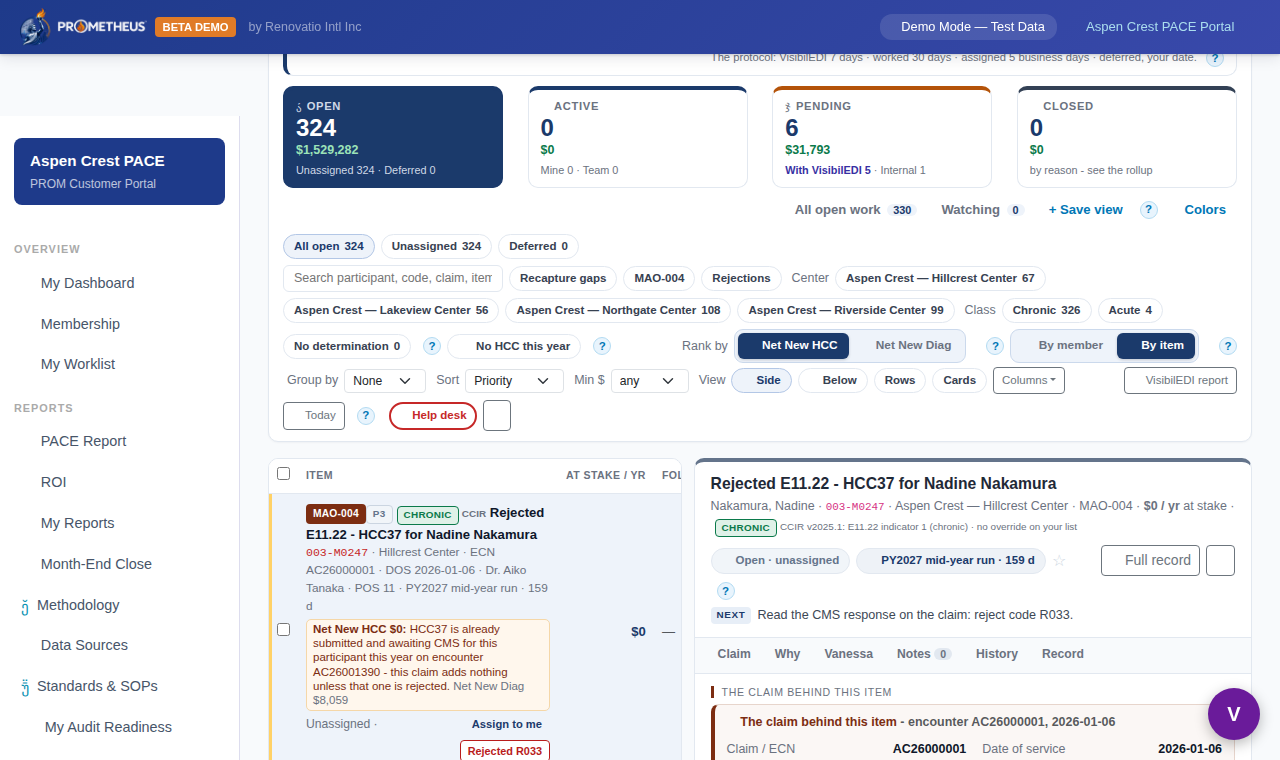
My Worklist: where the day starts
One item per participant and condition, whatever the source — a condition documented last year and not this year, a diagnosis CMS rejected, an encounter CMS has not acknowledged — with what it is worth this payment year, the CMS run that makes it late, its MAO-004 state, who holds it and when it is due. It flows the way work flows: Open, Active, Pending, Closed.
- By member or by item: the list on the left, the work on the right — the claim behind the item, why it is here, Vanessa's next steps with the source of each, notes, history
- Four actions, each with a follow-up date: Assign, Defer, Worked, Send to VisibilEDI. Overdue, due today and due soon are counted from those dates, never guessed
- Ranked by what each claim adds — Net New HCC: CMS pays an HCC once per participant per year, so a rejected claim whose category is already credited, already submitted and awaiting CMS, or outranked in the CMS hierarchy reads $0 and says why, naming the encounter that carries it; a higher category over a lower one already in is priced at the difference only. Net New Diag, one click away, shows every claim at its own value
- No HCC this year: one click lists the participants with a condition credited last year and none credited yet this year, by how many are expected back — drawn from the roster, with the documented codes, what is awaiting CMS and an Excel export. PROMETHEUS never suggests a diagnosis; the chart and the provider decide
Synthetic demonstration data — no real participant information.
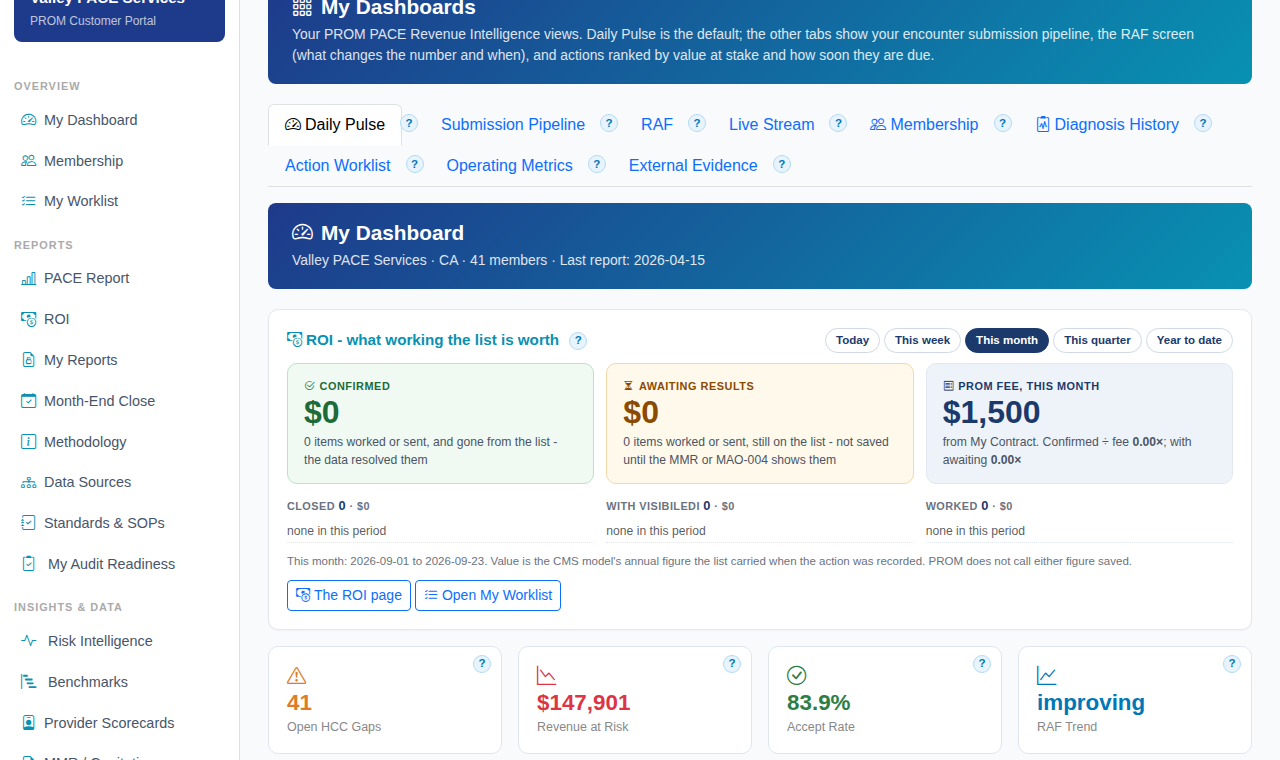
My Dashboard: ROI first, then Daily Pulse
The first card is what working the list is worth — Confirmed (value CMS's own file now shows for items your team worked or sent), Awaiting results, and the fee for the period, with the multiple. PROMETHEUS never calls any of it saved. Under it, Daily Pulse: open gaps, revenue at risk, acceptance rate and RAF trend, recalculated against your current data, not a quarter-old extract.
- The claims-to-CMS imbalance: what your claims support, what CMS credited, the difference, and the members behind it
- Every diagnosis you submitted in one of five states — credited, accepted but not priced, rejected, not seen by CMS, awaiting — with the reason and the fix
- Click any revenue figure for the line-by-line calculation behind it; a (?) on every window says how it was built
Synthetic demonstration data — no real participant information.
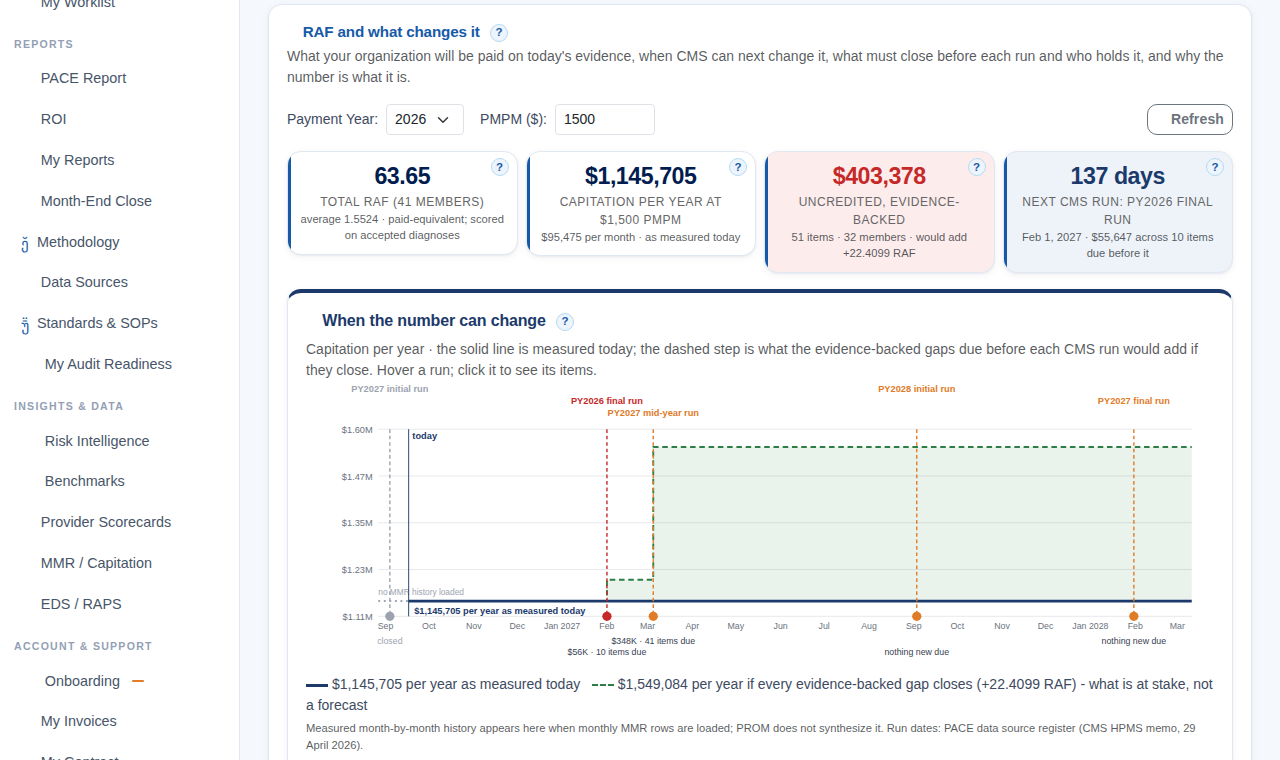
RAF, and what changes it
The four questions a CFO actually asks, in order: what will we be paid on today's evidence, when can CMS next change it, what must close before each run and who holds it, and why the number is what it is. Measured figures, not a projection.
- Paid-equivalent RAF — normalized, coding-adjusted, blended at the PACE weights, frailty added — verified score for score against CMS's own model software
- A step chart on the CMS run dates: the solid line is measured today, the dashed step is what the evidence-backed gaps due before each run would add — labeled as what is at stake, never as a forecast
- Click a run, a segment or an owner to drill to the members and the record; PROMETHEUS never proposes a diagnosis
Synthetic demonstration data — no real participant information.
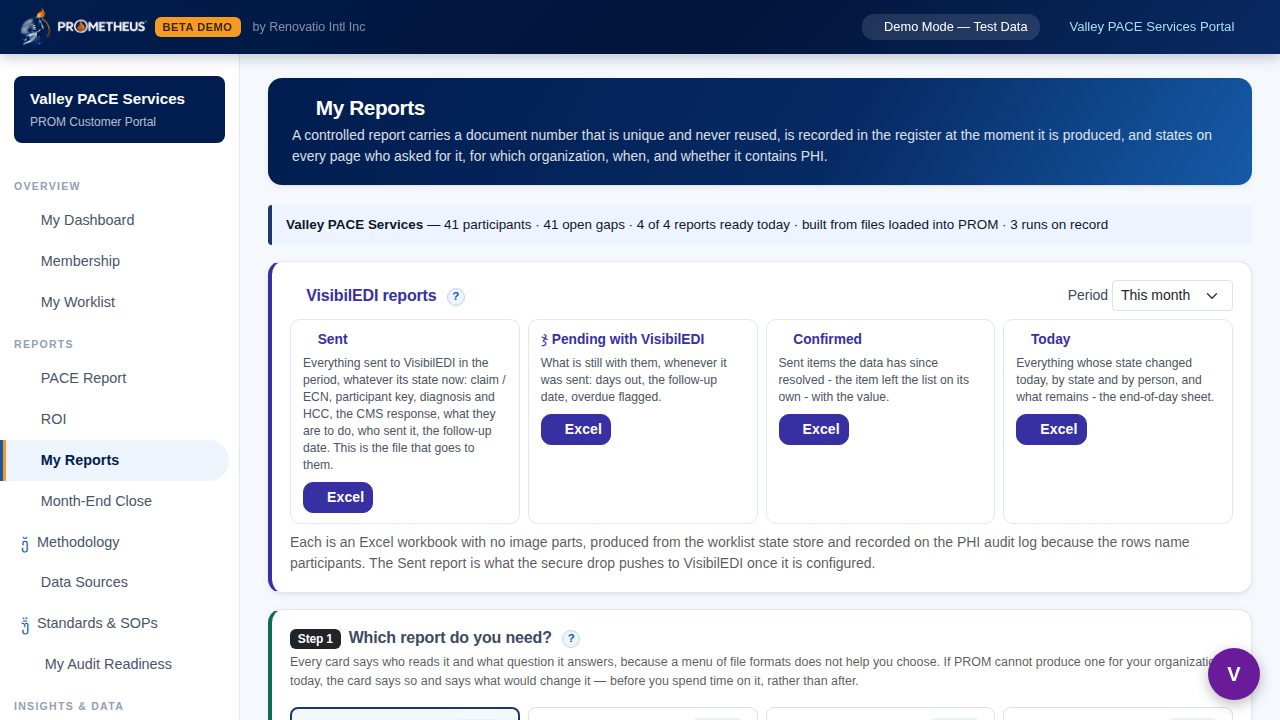
Reports that say who reads them
Every report card says who reads it and what question it answers before you spend time on it. Each is a controlled document: a number that is never reused, recorded in the register the moment it is produced, stating on every page who asked for it, for which organization, when, and whether it contains PHI.
- The VisibilEDI cards: Sent, Pending with VisibilEDI, Confirmed and Today — each as Excel
- Report Pack, Working List, Month-End Review, Revenue Bridge — and if PROMETHEUS cannot produce one for your organization today, the card says so and what would change it
- Your measured figures, period over period, with the fingerprint of the data behind each run — no peer figure PROMETHEUS cannot stand behind
Synthetic demonstration data — no real participant information.
Encounter integrity, end to end
Every submission tracked from generation to CMS acknowledgment, with rejections grouped by cause rather than listed by the thousand. Fix the pattern once instead of the symptom two hundred times.
- EDS / RAPS submission pipeline with MAO-004 reconciliation per diagnosis — one HCC counted once per member per year, so the dollars never double
- Rejections clustered by code and root cause; each one a worklist item with the CMS run that can still carry it
- Audit-readiness view and a PHI access log built from the same evidence trail
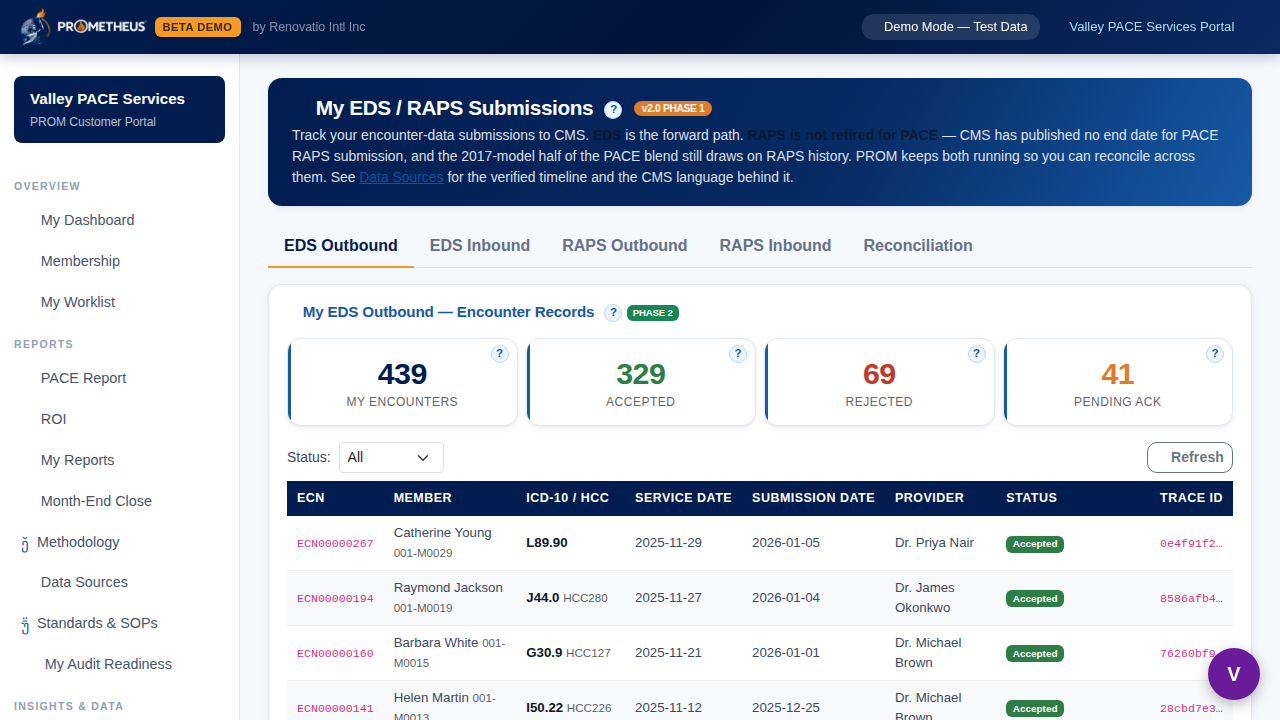
Synthetic demonstration data — no real participant information.
Every center, side by side
Participants, average risk, annual capitation, open gaps and revenue at risk for each center, ranked — with the arithmetic that produced them on the same screen. Organization averages are participant-weighted, never an average of center averages, and PROMETHEUS shows you what the difference would have been rather than asking you to take it on trust.
Diagnosis history, year over year
One row per participant per diagnosis per year: what CMS accepted, what is still sitting in the claim system, and what each one is worth. Built to answer the question a PACE coder actually asks — which of last year’s conditions have not come back this year, and what is that costing.
Built for more than one person on the file
Assign to me, Take over, Release — every hand-off recorded with a name. Tabs for All, Mine, Team, Watching, Unassigned and Deferred; watch an item or a member; a coder sees the center, the organization's lead sees them all. Nobody's work is ever reassigned by the software.
Help on every screen
A (?) on every number tile and panel explains what the figure is and how it was built. One red life ring is the help desk everywhere — from a worklist row it raises a ticket with your notes attached. Vanessa, PROMETHEUS's assistant, answers from the help library and says where each answer came from.
A close your CFO can defend
Month-End Close gives finance a calendar, a checklist, an evidence pack with a manifest — report job id, data hash, build, engine checksum, file hashes — and a sign-off. Six months later anyone can regenerate the identical report and prove it matches.
Four steps, and none of them are "rip out your EHR".
Connect
PROMETHEUS reads your existing encounter and diagnosis data where it already lives. Read-only, tenant-scoped, no new data pipeline for your team to own.
Detect
Three engines run in parallel across recapture, encounter quality and RAF, scored the way CMS pays PACE — the published blend, normalization, coding adjustment and frailty — and checked against CMS's own model software before every release.
Prioritize
Findings arrive as a ranked worklist with the dollars, the member, the provider, the CMS run that can still carry it and who holds it — not as a 4,000-row export.
Prove
Every figure traces back to its source records. Files are generated and held; transmission to CMS is a separate, deliberate, individually audited step.
Four things a general-purpose risk tool cannot say.
Every number shows its work
Every formula in the product is recomputed from its published parts and compared against the figures your own organization is shown — on every build. A disagreement fails the build rather than reaching you.
Risk scores are matched against CMS’s own model software: 420 test cases in both the 2017 and 2024 models, largest difference 0.000000.
It is a PACE product
PACE has roughly 200 programs and 91,000 participants nationally — small enough that the category is served mostly by tools designed for a different line of business. PROMETHEUS is built for the model PACE is actually paid under.
Program counts: National PACE Association, 2026.
It sits where the data already is
Built in partnership with VisibilEDI, whose gateway already carries encounter transactions for government-program health plans. PROMETHEUS analyzes the same substrate rather than asking you to build a second one.
It is engineered to be audited
Append-only audit trail, seven-year retention, tamper detection, per-tenant scoping enforced at three layers, and a documented readiness gate before any real participant data can enter the system.
Short answers, no hedging.
Is PROMETHEUS built for PACE, or is it a Medicare Advantage tool with a new label?
Only for PACE. It scores every participant the way CMS pays PACE organizations for the payment year — the published PACE blend of the CMS-HCC models, normalized and coding-adjusted, with the organization's frailty factor added — and shows the raw score beside the paid-equivalent one. The scoring is verified score for score against CMS's own model software before every release.
Does PROMETHEUS submit anything to CMS?
No. PROMETHEUS generates the evidence and the file; a person decides what goes to CMS. Transmission sits behind an explicit gate, only in live mode, and every transmission is individually audited.
Does PROMETHEUS suggest diagnoses?
Never. It shows what a participant's own record supports — a condition documented last year and not this year, a diagnosis CMS rejected, an encounter CMS has not acknowledged — with the source beside each item. Clinical judgment stays with the clinician; the coder documents what was found.
What data does it read?
The encounter and diagnosis data a PACE program already submits, the EDS and RAPS acknowledgments (MAO-002 and MAO-004), and the enrollment and capitation detail — read-only, tenant-scoped, on the same EDI substrate the encounters already travel on, through the partnership with VisibilEDI. Nothing is re-keyed.
How does PROMETHEUS count what it is worth?
In three figures it never blends: Confirmed — value CMS's own file (the MAO-004 or the MMR) now shows for items your team worked or sent; Awaiting results — sent or worked, not yet in CMS's file; and the fee for the period. PROMETHEUS never calls any of it saved.
Is real participant data used in the demo?
No. Every demonstration runs on synthetic data, and the switch from demo to live is a control in the software: it stays unavailable until the business associate agreement, encryption, access control and audit criteria for that organization are true and signed.
How do I see it?
Request a demo. A guided walkthrough on synthetic PACE data takes about thirty minutes; nothing to install.
Thirty minutes. Your questions, our data.
We'll walk your team through the live application on a synthetic PACE dataset, then talk honestly about what connecting your own data would take.